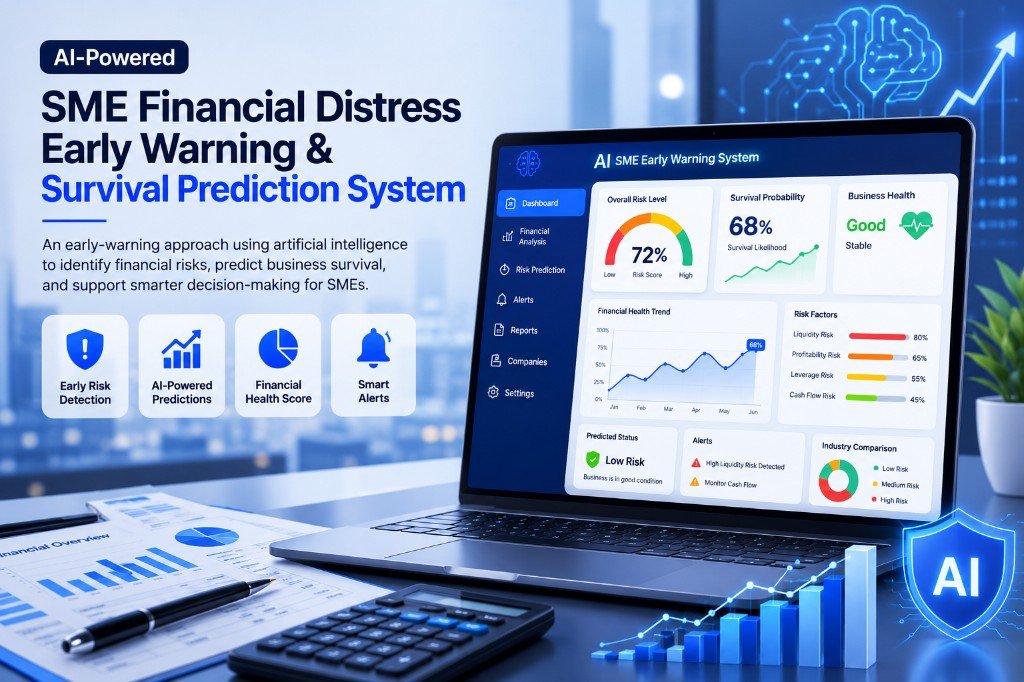
The AI-Based SME Financial Distress Early Warning & Survival Prediction System focuses on developing an intelligent framework capable of identifying early signs of financial vulnerability among small and medium-sized enterprises (SMEs) in Pakistan before they develop into severe distress or business failure. The system can integrate indicators such as liquidity, profitability, leverage, cash-flow pressure, sales trends, debt-servicing capacity, credit behaviour, and selected non-financial characteristics to assess financial health. The importance of this issue is reinforced by the World Bank’s Pakistan Development Update, which notes that SMEs constitute the vast majority of firms in Pakistan but receive only about 5.4% of outstanding private-sector credit, demonstrating their continued financial vulnerability and constrained access to formal finance.
The project applies artificial intelligence and machine-learning techniques to historical financial and business data to identify complex patterns associated with distress and estimate the probability of SME survival. Rather than relying only on conventional financial ratios or identifying problems after they become critical, an AI-based early-warning system can combine multiple indicators to classify firms by risk and provide timely signals for intervention. The World Bank Enterprise Survey for Pakistan further highlights the financing challenge: access to finance was reported as the biggest business obstacle by 14.3% of surveyed establishments, while World Bank analysis found that only 2.1% of surveyed firms had an outstanding loan, with high interest rates, complex procedures, and collateral requirements among important barriers to borrowing.
The system has strong practical potential for SMEs, commercial banks, financial institutions, regulators, investors, and policymakers. Risk scores and early-warning indicators could help SMEs take corrective action earlier while enabling lenders to improve credit assessment, portfolio monitoring, and targeted financial support. This is particularly relevant as the State Bank of Pakistan reported that outstanding SME finance increased from PKR 491 billion in June 2024 to PKR 691 billion in June 2025—an increase of 40.7%—while the number of SME borrowers rose from approximately 176,000 to 276,000. An effective AI-supported distress prediction system could therefore contribute to lower business-failure risk, better credit decisions, improved SME resilience, responsible financing, and stronger survival and growth of Pakistan’s SME sector.